
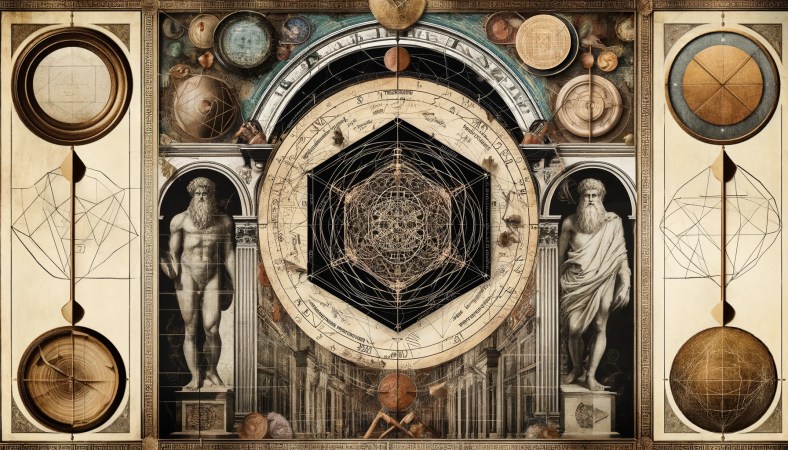
In the annals of human creativity, few figures shine as brilliantly as Leonardo da Vinci, the quintessential Renaissance man whose genius transcended the boundaries of art, science, and engineering. Yet, beneath the surface of his celebrated works lies a profound secret, a cosmic language that resonates with the harmonies of the universe itself – the sacred geometry that formed the foundation of his artistic and intellectual pursuits.
Da Vinci’s insatiable thirst for knowledge led him to explore the intricate tapestry of mathematics, geometry, and cosmology, weaving these strands into a tapestry that revealed the underlying patterns of existence. His works, from the iconic Mona Lisa to his awe-inspiring architectural designs, were not mere expressions of aesthetic beauty but rather embodiments of a deeper, more profound understanding of the cosmos.
At the heart of da Vinci’s sacred geometry lies the profound influence of the Roman architect and engineer Vitruvius, whose seminal work, “De architectura,” served as a guiding light for the Renaissance master. Vitruvius’ teachings, rediscovered and revived during the Renaissance, ignited a profound fascination with the ancient knowledge of engineering, mathematics, and the harmonies that governed the natural world.
Like a modern-day alchemist, da Vinci sought to unravel the mysteries of the ancients, delving into the works of Euclid, the father of geometry, and studying the intricate patterns that permeated the very fabric of existence. His notebooks, filled with meticulously rendered illustrations and calculations, bear witness to his relentless pursuit of understanding, a quest that transcended the boundaries of mere observation and experimentation.
One of the most iconic representations of da Vinci’s mastery of sacred geometry is his interpretation of the Vitruvian Man, a masterful synthesis of human anatomy and the divine proportions that underpin the cosmos. In this celebrated work, da Vinci seamlessly blends the human form with the geometric perfection of the circle and square, representing the harmonious union of heaven and earth, spirit and matter.
Yet, da Vinci’s exploration of sacred geometry extended far beyond the confines of art. His engineering marvels, from intricate machine designs to architectural wonders, were imbued with the same profound understanding of cosmic harmonies. He studied the geometric principles that governed the transfer of forces through arches, calculated gear ratios with precision, and even applied the golden ratio – the divine proportion revered by ancient architects and artists – to his creations.
As da Vinci delved deeper into the realm of sacred geometry, he encountered the profound wisdom of the Platonic solids, the five perfect polyhedra that were believed to embody the fundamental building blocks of the universe. These geometric forms, revered by the ancient Greeks and later explored by the Renaissance thinkers, became a recurring motif in da Vinci’s work, appearing in his illustrations and serving as a testament to his deep reverence for the harmonies that underpin all existence.
But da Vinci’s genius extended beyond mere representation; he sought to unlock the very essence of creation itself. In his exploration of the Flower of Life, an ancient symbol that encapsulates the blueprints of the cosmos, da Vinci unveiled a profound truth – that all geometric forms, from the simplest to the most complex, could be derived from this primordial pattern.
As he meticulously constructed the intricate geometries of the Flower of Life, da Vinci unveiled a vast tapestry of interconnected shapes and forms, each revealing a deeper layer of cosmic truth. From the seed of life to Metatron’s Cube, da Vinci’s drawings became portals into a realm of profound understanding, where the boundaries between art, science, and spirituality dissolved into a harmonious union.
In this sacred pursuit, da Vinci embraced the wisdom of ancient cultures, delving into the mystical traditions of the Egyptians, Greeks, and Romans, seeking to uncover the universal language that underpinned their profound understanding of the cosmos. He recognized that art, music, and architecture were not mere expressions of human creativity but rather manifestations of a cosmic symphony, a symphony whose harmonies could be deciphered through the study of sacred geometry.
As we stand in awe of da Vinci’s legacy, we are reminded that true genius lies not in the mere accumulation of knowledge but in the ability to perceive the interconnectedness that binds all things together. Through his mastery of sacred geometry, da Vinci unveiled a profound truth – that the universe itself is a canvas upon which the divine architect has painted the most exquisite masterpiece, a masterpiece whose harmonies resonate through every aspect of existence, from the orbits of celestial bodies to the intricate patterns that adorn the petals of a flower.
In da Vinci’s works, we find a bridge between the seen and the unseen, the tangible and the ineffable, a testament to the human spirit’s capacity to transcend the limitations of mere perception and glimpse the cosmic tapestry that underpins all of creation. As we stand in reverence before his creations, we are invited to embark on a journey of self-discovery, to unlock the sacred geometries that reside within our own minds and souls, and to embrace the profound truth that we are not mere observers in this grand cosmic symphony but active participants, co-creators in the unfolding of the divine masterpiece.








Add comment