
Have you ever looked at a spider’s web and marveled at its intricacy? Each delicate strand is connected to another, forming a beautiful tapestry that is both strong and fragile. In many ways, the web is a perfect metaphor for the interconnectedness of all things.
As Alan Watts once said, “The world is a web, a fabric of inter-related processes and events. We are not separate entities, but integral parts of this web.”
And yet, in our modern world, we often forget this fundamental truth. We see ourselves as isolated individuals, disconnected from each other and the natural world around us. We treat the Earth as a resource to be exploited, rather than a living system to be nurtured and respected.
But as the Tao Te Ching reminds us, “The Tao is the sustaining Life-force and the mother of all things. The wise sees the world as the world sees itself, without attachment, without judgment, embracing the one.”
So, how can we embrace this holistic, eco-centric worldview in a world that seems hell-bent on tearing itself apart? Well, it starts with recognizing that we are not separate from nature, but an integral part of it.
Think about it this way: when you breathe in, you are taking in the same air that the trees exhale. When you eat a meal, you are consuming the energy of the sun, the soil, and the countless organisms that have played a role in bringing that food to your plate. We are all part of a vast, interconnected web of life.
And yet, we often act as if we are the only ones on the web that matter. We pollute the air and water, we destroy habitats, and we disrupt the delicate balance of ecosystems – all in the name of progress and profit.
But as the great Chief Seattle once said, “Humankind has not woven the web of life. We are but one thread within it. Whatever we do to the web, we do to ourselves.”
So, how can we start to repair the web and embrace a more holistic, eco-centric worldview? It starts with small actions, like reducing our consumption, supporting sustainable practices, and treating all living things with compassion and respect.
But it also requires a fundamental shift in our thinking. We need to stop seeing ourselves as the center of the universe and start recognizing our place within the larger web of life. We need to cultivate a sense of awe and reverence for the natural world, and understand that our well-being is intrinsically linked to the health of the planet.
As Watts put it, “You are a function of what the whole universe is doing in the same way that a wave is a function of what the whole ocean is doing.”
So, let’s ride the wave, my friends. Let’s surrender to the flow of the Tao and trust in the wisdom of the web. Let’s embrace our interconnectedness and work towards a world where all living things can thrive.
And if we ever feel lost or disconnected, we need only look to nature for guidance. As the Tao Te Ching reminds us, “Nature does not hurry, yet everything is accomplished.”
So, let’s take a deep breath, my friends. Let’s slow down and tune into the rhythms of the Earth. Let’s find our place in the web of life and marvel at the beauty and complexity of it all.
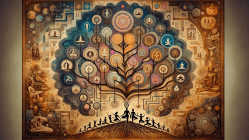
And let’s remember, as Alan Watts so eloquently put it, “We do not ‘come into’ this world; we come out of it, as leaves from a tree. As the ocean ‘waves,’ the universe ‘peoples.’ Every individual is an expression of the whole realm of nature, a unique action of the total universe.”
We are all leaves on the great tree of life, my friends. Let’s dance in the wind, bask in the sunlight, and trust in the wisdom of the web. For in embracing our interconnectedness, we just might find the key to healing ourselves and the planet we call home.


Add comment