
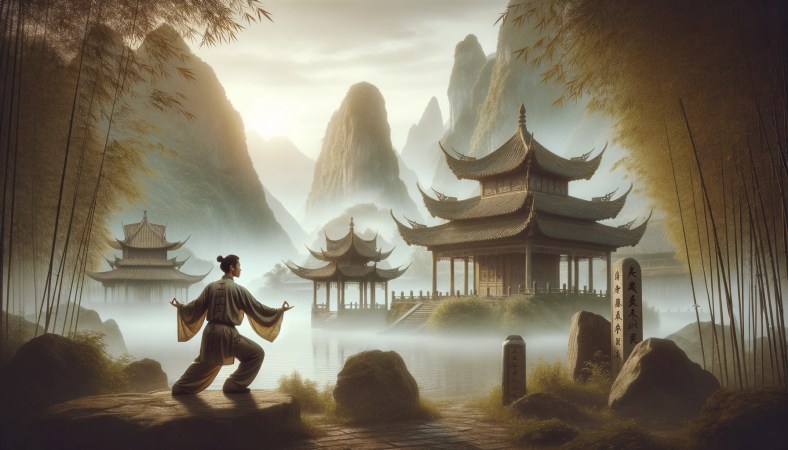
Welcome, dear reader, to an exciting journey through time and wisdom. As we explore the world of Tai Chi, I invite you to imagine yourself as a curious and open-minded traveler, ready to uncover the secrets of this gentle yet powerful martial art. Together, we will trace the fascinating origins of Tai Chi, from its beginnings in ancient Chinese philosophy and martial arts to the beloved practice it has become today. So, take a deep breath, relax your mind, and let us enter a world of harmony, balance, and inner peace.
The Beginnings of Tai Chi
Our journey starts over 2,500 years ago in ancient China, a land rich in philosophical traditions and martial arts history. During this time, the foundations of Tai Chi were laid, drawing inspiration from Taoist and Confucian thought. In their deep wisdom, the ancient Chinese sages understood the interconnectedness of all things and the importance of creating harmony between the body, mind, and spirit.
At the core of Tai Chi lies the idea of yin and yang, the complementary forces that shape the universe. Just as day turns into night and light exists alongside shadow, Tai Chi teaches us to balance and embrace the opposing energies within ourselves and the world around us. By understanding this principle of dynamic balance, we learn to face life’s challenges with grace, flexibility, and resilience.
The Energy of Life:
As we explore the philosophy of Tai Chi further, we come across the essential concept of qi – the life energy that flows through all living beings. The ancient Chinese believed that qi moves through a network of pathways in the body, nourishing our organs, muscles, and tissues. When the flow of qi is balanced and unblocked, we experience optimal health, vitality, and well-being.
Tai Chi, with its slow, flowing movements and deep, mindful breathing, serves as a powerful tool for cultivating and balancing the flow of qi. Each graceful movement, each intentional breath, invites us to connect with our inner energy, releasing blockages and allowing qi to flow freely. As we practice Tai Chi, we become more aware of the subtle sensations and rhythms of our own life force, fostering a deep sense of unity and wholeness.
The Development of a Martial Art:
While the philosophical roots of Tai Chi run deep, its development as a martial art is equally interesting. Legend has it that Tai Chi was born when a Taoist sage, Chang San-Feng, witnessed a fascinating battle between a crane and a snake. Inspired by their fluid, circular movements and the effortless way they yielded and overcame, Chang San-Feng developed the early forms of Tai Chi, infusing them with the principles of softness, flexibility, and strategic positioning.
As Tai Chi developed over the centuries, it absorbed influences from various martial arts styles, such as Bagua and Xing Yi, while maintaining its core emphasis on relaxation, sensitivity, and inner strength. Unlike more aggressive martial arts, Tai Chi focuses on neutralizing an opponent’s force rather than meeting it head-on. By yielding and redirecting, a skilled Tai Chi practitioner can overcome even the most formidable adversary with minimal effort and maximal efficiency.
The Benefits of Tai Chi:
Today, Tai Chi has spread far beyond the borders of China, touching the lives of millions worldwide. Its gentle, flowing movements and meditative qualities have made it a beloved practice for people of all ages and backgrounds, offering a sanctuary of peace and tranquility amidst the chaos of modern life.
But Tai Chi is more than just a physical exercise; it is a vehicle for personal transformation and self-discovery. As we immerse ourselves in the practice, we begin to cultivate a deeper awareness of our thoughts, emotions, and bodily sensations. We learn to let go of tension, stress, and negative patterns, replacing them with a sense of groundedness, clarity, and inner harmony.
In my own journey with Tai Chi, I have discovered a profound truth: that the greatest battles we face are not external, but internal. By embodying the principles of yin and yang, the flow of qi, and the harmony of mind, body, and spirit, we develop the inner strength and resilience to navigate life’s challenges with grace and equanimity. Tai Chi becomes a mirror, reflecting back to us our own potential for growth, healing, and transformation.
Conclusion:
As we come to the end of our journey through the ancient roots of Tai Chi, I hope that you, dear reader, have gained a deeper appreciation for the richness and depth of this remarkable practice. From its philosophical origins to its evolution as a martial art, Tai Chi offers us a timeless wisdom that transcends the ages.
So, as you step back into the world, I invite you to carry with you the lessons of Tai Chi. Embrace the balance of yin and yang, the flow of qi, and the harmony of mind, body, and spirit. Let your practice be a sanctuary, a place of refuge and renewal, where you can connect with your innermost self and tap into the vast reservoir of wisdom that lies within.
Remember, the path of Tai Chi is a lifelong journey, one that unfolds with each breath, each movement, and each moment of presence. Trust in the process, be patient with yourself, and allow the ancient wisdom of Tai Chi to guide you towards a life of greater harmony, balance, and inner peace.
As a final thought, I leave you with the words of the great Taoist sage, Lao Tzu: “The journey of a thousand miles begins with a single step.” May your journey with Tai Chi be filled with joy, discovery, and the unfolding of your own limitless potential. Embrace the dance of life, one mindful step at a time.












Add comment